All-on-4 vs Multiple Individual Implants: Which Full-Arch Solution Is Right for You?
Compare All-on-4 and individual dental implants, including cost, stability, bone requirements, treatment stages and maintenance, to understand your options.
Losing most or all of your teeth can affect much more than your smile. Everyday activities such as eating, speaking and feeling comfortable in social situations may become more difficult. If you are considering replacing a full arch of missing teeth, dental implants can offer a stable alternative to conventional removable dentures.
Two options you may come across are All-on-4 dental implants and multiple individual dental implants. Both use implants placed in the jawbone to support replacement teeth, but they differ in how many implants are used, how the teeth are designed and what the treatment involves.
So, which option is right for you? The answer depends on your oral health, bone condition, bite, treatment goals and budget. Understanding the differences can help you have a more informed conversation with your dental team.
At Egham Dental Care Implant and Cosmetic Centre, patients exploring tooth replacement can discuss their options with a dentist and understand which approach may be suitable for their circumstances. Whether you are looking for an implant dentist near Windsor or researching full-mouth dental implants, it is worth understanding how these treatments compare before making a decision.
What Are All-on-4 Dental Implants?
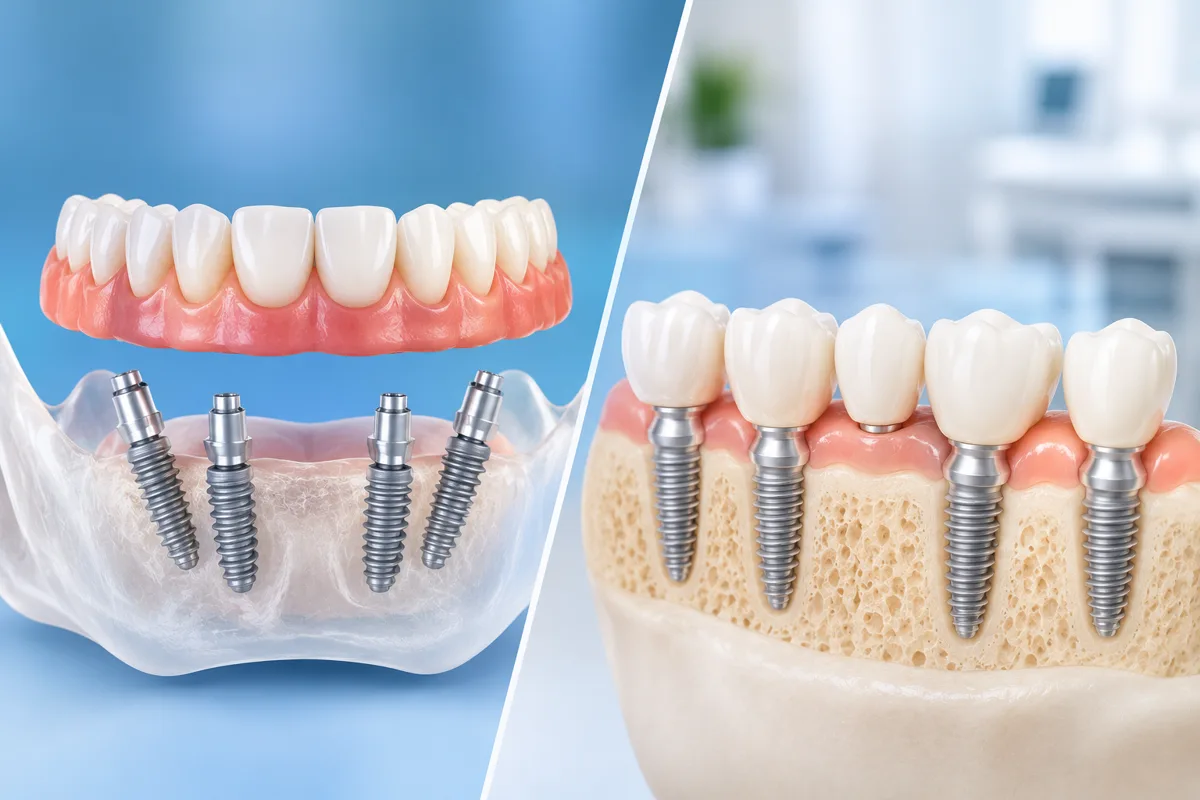
All-on-4 is a full-arch tooth replacement approach that uses four strategically positioned dental implants to support a fixed bridge of replacement teeth. The implants are placed in the jawbone, where they act as artificial tooth roots. Once the implants have integrated with the bone and the treatment plan allows, they support a complete set of replacement teeth.
The technique often involves placing the two front implants vertically and angling the two back implants. This positioning can help make use of the available bone and may reduce the need for bone grafting in some patients. However, it does not eliminate the need for grafting in every case.
How Does the All-on-4 Procedure Work?
Treatment usually involves several stages:
- Initial consultation: Your dentist assesses your teeth, gums, bite and general oral health.
- Imaging and planning: Dental X-rays and, where clinically appropriate, a CBCT scan may be used to assess the jawbone and plan implant positions.
- Implant placement: Four implants are placed in the jawbone under an appropriate form of anaesthesia.
- Temporary teeth: Some suitable patients may receive a temporary fixed bridge during or shortly after surgery. This depends on implant stability and the clinical plan.
- Final restoration: After the healing and integration period, the temporary teeth are replaced with the planned final bridge.
Not everyone is suitable for immediate temporary teeth. Your dentist will explain whether this is realistic based on your bone quality, implant stability and individual circumstances.
What Are Multiple Individual Dental Implants?
Multiple individual dental implants involve placing several implants throughout the jaw to replace missing teeth. Rather than supporting one full-arch bridge on four implants, this approach uses a greater number of implants, often with separate crowns or connected bridges attached to them.
For someone missing most or all teeth, multiple implants may be used to support several sections of fixed replacement teeth. The exact number depends on the shape of the jaw, available bone, bite forces and the design of the final restoration.
How Does This Approach Work?
The treatment process generally includes:
- Assessment: Your dentist reviews your medical and dental history, gum health, remaining teeth and jawbone condition.
- Treatment planning: Imaging helps determine where implants can be placed and how the replacement teeth will be supported.
- Implant placement: Several implants are positioned in the jaw, either during one procedure or across multiple appointments.
- Healing: The implants need time to integrate with the surrounding bone.
- Restoration: Individual crowns or connected bridges are attached once the implants are ready to support them.
Multiple individual implants can provide flexibility in how missing teeth are restored. However, placing more implants does not automatically make a treatment more suitable or provide a better result. The number and position must be planned around your clinical needs.
All-on-4 vs Multiple Individual Implants: Key Differences
Both approaches can restore a full arch of teeth, but they have important differences.
1. Number of Implants
The most obvious difference is the number of implants used.
All-on-4 is designed around four implants supporting a full-arch bridge. Multiple individual implants use a higher number of implants, with the precise number depending on the treatment plan.
A greater number of implants may offer additional support in certain situations, but it is not always necessary. Four well-positioned implants may be sufficient for some patients, while others may benefit from a different configuration.
2. Type of Replacement Teeth
With All-on-4, the replacement teeth are generally connected as one full-arch bridge. The restoration is fixed in place and is not designed for the patient to remove at home.
With multiple individual implants, the replacement teeth may consist of separate crowns or smaller connected bridges. This can make the restoration more segmented, depending on the number and position of missing teeth.
Your dentist will consider appearance, cleaning access, bite and long-term maintenance when recommending the design.
3. Bone Availability
Jawbone condition plays an important role in implant treatment.
All-on-4 may allow implants to be placed in areas where bone is more readily available. Angling the back implants can sometimes help avoid anatomical structures and reduce the need for additional grafting.
Multiple individual implants may require adequate bone at several implant sites. If bone has been lost following tooth loss or gum disease, bone grafting may be considered.
A clinical examination and suitable imaging are needed to understand what is possible in your case.
4. Treatment Complexity and Recovery
Both treatments involve oral surgery and a healing period. The experience will depend on the number of implants, whether teeth need to be removed, whether grafting is required and your general health.
All-on-4 may involve fewer implant sites, but it is still a significant full-arch procedure. Multiple individual implants may involve more surgical sites and, in some cases, several treatment stages.
Neither option should be described as a quick or effortless solution. Your dentist should explain the expected recovery, dietary restrictions and follow-up appointments before treatment begins.
5. Cleaning and Maintenance
Good daily hygiene is essential for both types of restoration.
A fixed All-on-4 bridge needs careful cleaning underneath and around the restoration. Special floss, interdental brushes or water flossers may help, depending on the bridge design.
Individual implant crowns may allow access between teeth that is similar to natural teeth, although cleaning requirements vary. Connected bridges also need attention around and beneath the restoration.
Regular dental reviews and professional maintenance are important because implants can develop complications, including peri-implant disease, if the surrounding tissues are not kept healthy.
Which Option Is More Suitable for You?
There is no single solution that suits everyone. Your dentist will assess several factors before recommending a treatment.
You May Be Considered for All-on-4 If:
- You have lost most or all teeth in one jaw.
- You want a fixed full-arch restoration rather than a removable denture.
- Your jawbone condition allows four implants to be placed in suitable positions.
- A full-arch bridge is appropriate for your bite and oral health.
- You prefer a treatment plan that uses fewer implants, where clinically suitable.
Multiple Individual Implants May Be Considered If:
- You need to replace several missing teeth rather than an entire arch with one bridge.
- Your bone condition and anatomy allow several implant sites.
- Separate crowns or smaller bridges are suitable for your restoration.
- Your dentist considers a more distributed implant arrangement appropriate for your bite and long-term needs.
These are general considerations, not rules for choosing treatment. Some patients may be suitable for both approaches, while others may need a different option altogether.
Factors Your Dentist Will Assess Before Recommending Treatment
Before proceeding with full-arch dental implants, your dentist will need to understand your overall oral health and treatment requirements.
Gum Health and Existing Dental Problems
Active gum disease should be assessed and managed before implant treatment. Healthy gums and good oral hygiene help support the tissues around dental implants. Any remaining teeth with infection or significant damage may also need attention.
Jawbone Volume and Quality
The jawbone needs to provide suitable support for dental implants. Tooth loss can lead to gradual bone resorption, which may affect implant placement. Dental imaging helps assess bone volume and identify important anatomical structures.
General Health and Medical History
Certain medical conditions, medications and lifestyle factors can affect healing and implant treatment. Smoking, for example, can increase the risk of implant complications. Share your full medical history with your dentist so that your treatment can be planned appropriately.
Bite and Jaw Function
Your bite affects how pressure is distributed across the replacement teeth and implants. Habits such as teeth grinding or clenching may also influence the restoration design and maintenance plan.
Are Full-Arch Dental Implants Better Than Dentures?
Full-arch dental implants and conventional dentures serve different needs.
Traditional dentures are removable and rest on the gums. They do not require implant surgery and may be suitable for people who prefer a non-surgical option or are not suitable for implants.
Implant-supported teeth are anchored to implants in the jawbone. Depending on the design, they may offer greater stability during eating and speaking than conventional dentures. However, they involve surgery, healing time, ongoing maintenance and a higher initial financial commitment in many cases.
It is also important to remember that implant treatment does not remove the need for regular dental care. The implants and replacement teeth need to be checked and cleaned to help maintain their condition.
Why Choose a Consultation Before Deciding?
Online comparisons can help you understand the basics, but they cannot determine which treatment is suitable for your mouth. A proper assessment allows your dentist to examine your gums, bone, bite and remaining teeth before discussing the available options.
If you are comparing All-on-4 with multiple individual implants, ask about:
- The recommended number and position of implants.
- The type of bridge or crowns planned.
- Whether bone grafting or extractions may be needed.
- The expected treatment and healing timeline.
- Temporary teeth and when they may be fitted.
- Cleaning requirements and long-term maintenance.
- The full treatment costs and what is included.
If you are searching for a dentist in Windsor or considering treatment at Egham Dental Care Implant and Cosmetic Centre, a consultation can help you understand the options available and what each would involve.
Book a Dental Implant Consultation at Egham Dental Care Implant and Cosmetic Centre
Choosing between All-on-4 and multiple individual dental implants is an important decision. The right approach should take your oral health, jawbone condition, daily needs and long-term maintenance into account.
If you are considering full-arch dental implants, contact Egham Dental Care Implant and Cosmetic Centre to arrange a consultation. You can discuss your concerns, understand the treatment options and find out what may be suitable for your smile.

Call us or book your free consultation. We’re always happy to chat.
Frequently asked questions
Everything you need to know before your first appointment.
Is All-on-4 better than multiple individual dental implants?
Neither option is automatically better. All-on-4 uses four implants to support a full-arch bridge, while multiple individual implants use more implants to support separate crowns or connected bridges. The appropriate choice depends on your bone condition, bite, oral health and restoration needs.
How many teeth can All-on-4 dental implants replace?
All-on-4 is designed to support a complete arch of replacement teeth, usually replacing the teeth in the upper or lower jaw. The final number and design of teeth will depend on your treatment plan.
Do All-on-4 implants require bone grafting?
Not always. The positioning of the implants may help make use of the available jawbone and reduce the need for grafting in some patients. However, bone grafting may still be recommended if there is insufficient bone for safe and stable implant placement.
How long does full-arch dental implant treatment take?
Treatment timelines vary. Some suitable patients may receive temporary fixed teeth shortly after implant placement, while others need to wait for healing before receiving their restoration. The overall process can take several months, particularly if extractions or bone grafting are required.
Can I eat normally with All-on-4 dental implants?
Once your final restoration has been fitted and your dentist confirms that you can return to your usual diet, you may be able to enjoy a wide range of foods. During healing, you will usually need to follow dietary instructions and avoid putting excessive pressure on the implants.
How do I clean full-arch dental implants?
You will need to clean around the bridge and underneath it using suitable tools, such as interdental brushes, specialised floss or a water flosser. Your dental team can demonstrate the correct technique and recommend a maintenance schedule.
Can smokers have full-arch dental implants?
Smoking does not automatically rule out implant treatment, but it can affect healing and increase the risk of complications, including implant failure. Your dentist will discuss the risks and may recommend stopping smoking before and after treatment.
How do I know if I need a dentist in Windsor for dental implants?
If you are missing several teeth or considering replacing a full arch, arrange an assessment with a dentist who provides or coordinates implant treatment. They can examine your oral health, discuss suitable options and explain the next steps.
What happens at an initial full-arch implant consultation?
Your dentist assesses your teeth, gums, bite and general oral health. Imaging such as X-rays and, where clinically appropriate, a CBCT scan may be used to plan implant positions.
What our patients say.
"I’m a terrible patient, I’m anxious and I don’t floss! But Darren is an amazing hygienist he’s SO patient and gives practical advice to improve your oral health. He respects the anxiousness and always offers to give a break, which is highly appreciated ! And Dr Kiran is EPIC! Gentle hands and kind, matches your anxiousness with a careful pace , highly recommend her for fillings and regular check ups. She has also treated my husband for TMJ. After a lot of consideration and multiple opinions we are grateful to have gone with her as she has been so good at every step. So if you’re unfortunate to have bigger problems than just fillings, she’s fantastic at that too! And I have to add that Preeti at reception is always so helpful and friendly - and gives great advice!"
"It's been a few most since we started the journey of repairing the damage I've done to my teeth over the years and I don't normally hear from people that it's pleasure to go to the dentist but for me it is, he's patient, polite and chatty. He talks me through the next steps and gives me encouragement. Previous dentists was unpleasant and I always dreaded going but now I don't."
"I just wanted to say such a huge Thank you to the team at Egham Dental Practice for their care and professionalism today. I was absolutely dreading having my tooth out as I’m a very nervous patient but honestly Dr Jatin couldn’t have been kinder or more patient with me. Thank you."
"I had a broken tooth, and they accepted me an emergency appointment and fixed for me same day. Excellent service and very reliable dentist. I would definitely consider them for next time. Pricing was a bit expensive but 100% worth saving my day"
"very good! very kindly staff and the doctor very professional."
"What a great team. Very friendly and professional.They make you feel comfortable and at ease within the surgery. Excellent dental care. Recommended."
"Always an easy visit. Won’t say a pleasure but dentist never is. Everyone always kind and considerate. Special mention to Darren who kindly helped me with the stairs which are difficult for me. You have kindly agreed to see I am treated downstairs in future so will see you again in April. Many thanks"
"all good and very professional as usual. highly recommended."
We’re in Old Windsor.
96 Straight Road, Old Windsor, Berkshire, SL4 2RX. Free parking and easy access from Egham and Windsor.
Thank you, we have received your request
We will be in touch to arrange your complimentary consultation.
Book your free consultation.
No obligations. Honest advice. A clear treatment plan and a warm welcome at our Old Windsor practice.
Book a free consultationMeet the team